
In recent years, telecommunications operators have significantly increased their investments in fixed broadband networks, with the majority directed towards fibre deployment. As a result, fibre networks have expanded and the performance and capacity of connections have improved across Finland. However, in sparsely populated areas and outside urban settlements, fast fixed internet connections remain less widely available.
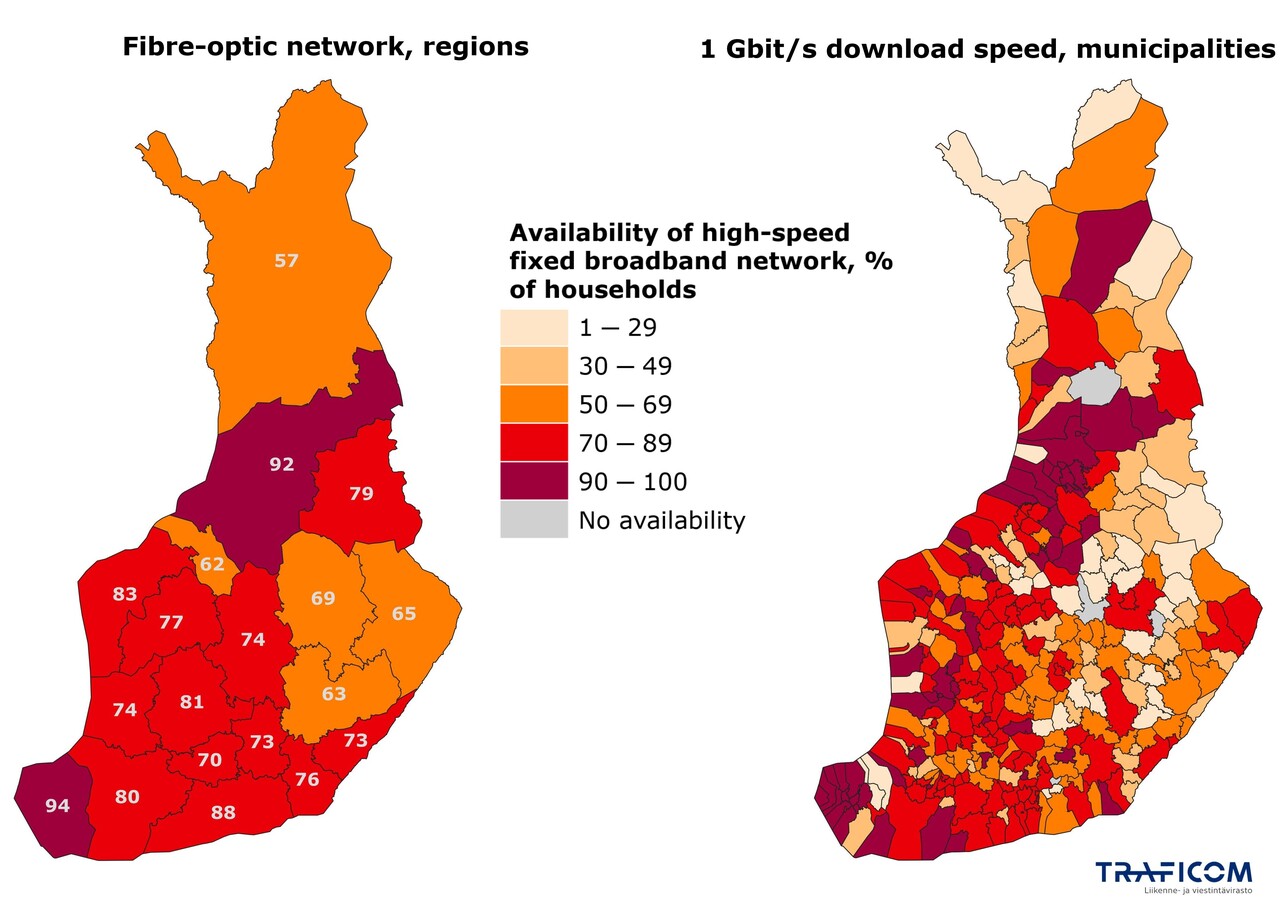
At the end of September 2025, fixed connections with a maximum download speed of at least 1 Gbps were available to 80% of households. According to data reported by telecommunications operators, the European Union’s targets for internet connection quality have already been met in almost 2.3 million households in Finland.
Fibre replaces legacy networks and brings high-quality fixed internet connections to new areas
Fibre-based broadband connections were available to 80% of households, an increase of 12 percentage points compared with one year earlier. A significant share of this growth is due to cable modem networks being replaced in many areas by fibre technology, which now increasingly extends all the way to the plot boundary or to the building distribution point. This provides consumers with higher-performing and longer-lasting connections. At the same time, fibre networks have also been extensively deployed in entirely new areas.
Fibre availability has improved in Päijät-Häme, North Savo and Satakunta, in particular. “Investments by telecommunications operators and municipalities are clearly visible in the improved availability of fast broadband connections, although regional differences remain significant. In eastern and northern Finland, the availability of fixed internet connections is clearly poorer than in other parts of the country,” says Director Lasse Laine at Traficom. “Investing in fixed networks is essential to ensure that good internet connections are available to both households and businesses across Finland,” Laine continues.
Long distance from existing networks indicates slower development of availability
The availability of fast fixed networks can also be assessed based on how close existing networks are to areas where networks are not yet available. “If these areas are far from population centres, network deployment can be more expensive and there are fewer potential customers than in more densely populated areas. As a result, network expansion into these areas may be relatively slow,” explains Senior Specialist Joonas Sotaniemi.
The map illustrates how far areas with household availability of 1 Gbps connections at the end of September 2025 are from locations where the network is not yet available. Distances are naturally longer in areas where availability is generally poor. In sparsely populated areas of Lapland, the distance to a high-speed network can be as much as 50–60 km. There are also areas in eastern Finland, Kainuu and Savo where the nearest existing network is more than 20 km away.

Traficom collects fixed network availability data annually from telecommunications operators. The aim is to monitor the development of networks in Finland.
Further information and enquiries
Situational picture: Development of fixed communications networks in Finland (External link)
Fixed broadband availability (External link)
Traficom map service (External link)
Telecommunications operators invested a record almost EUR 500 million in fixed networks last year (in Finnish)
Joonas Sotaniemi, Senior Specialist, tel. +358 29 539 0309, joonas.sotaniemi@traficom.fi