
Fibre optic connections available to nearly 2 million households
At the end of September 2024, fibre-optic network connections were available to 68% of Finnish households. In addition, 75% of households could opt for a fixed connection with a minimum download speed of 1 Gbps. Traficom has published new availability data as part of its situational picture on the development of fixed communications networks in Finland.
At the end of September 2024, Finland’s fibre-optic broadband network was made available to nearly 2 million homes, or 68% of Finnish households, representing a 7 percentage-point increase in availability over a single year. The best fibre-optic coverage was recorded in Åland (98%), Ostrobothnia (81%), North Ostrobothnia (81%), and Pirkanmaa (78%).
Europe aims to provide gigabit broadband connections for every home
According to the European Union’s digital development goals, all households should have access to 1 Gbps download speeds by 2030. Finland has also specified this goal in its own digital compass.
High-speed, 1 Gbps download speeds are primarily the domain of fibre-optic connections, but cable modem networks can also reach similar download speeds. Cable modem networks are more common especially in urban areas. “However, the primary advantage of the fibre-optic network is its support for higher upload speeds, which cannot generally be achieved on cable modem networks. Upload speeds become relevant in scenarios where users need to send large amounts of data, for example to cloud services,” explains Senior Specialist Joonas Sotaniemi.
At the end of September 2024, 1 Gbps download speeds were available to 75% of Finnish households, representing a 4 percentage-point increase in availability over the year. In 46 municipalities, over 89% of households could opt for gigabit broadband connections, while in 44 municipalities, household coverage remained below 30%. In addition, 13 municipalities had no gigabit options available.
High-speed broadband connections also include other connections with a download speed of at least 100 Mbps, which were available to 81% of households. Many of these networks could also be updated to enable gigabit speeds by making minor changes to, for example, the networking hardware used by operators.
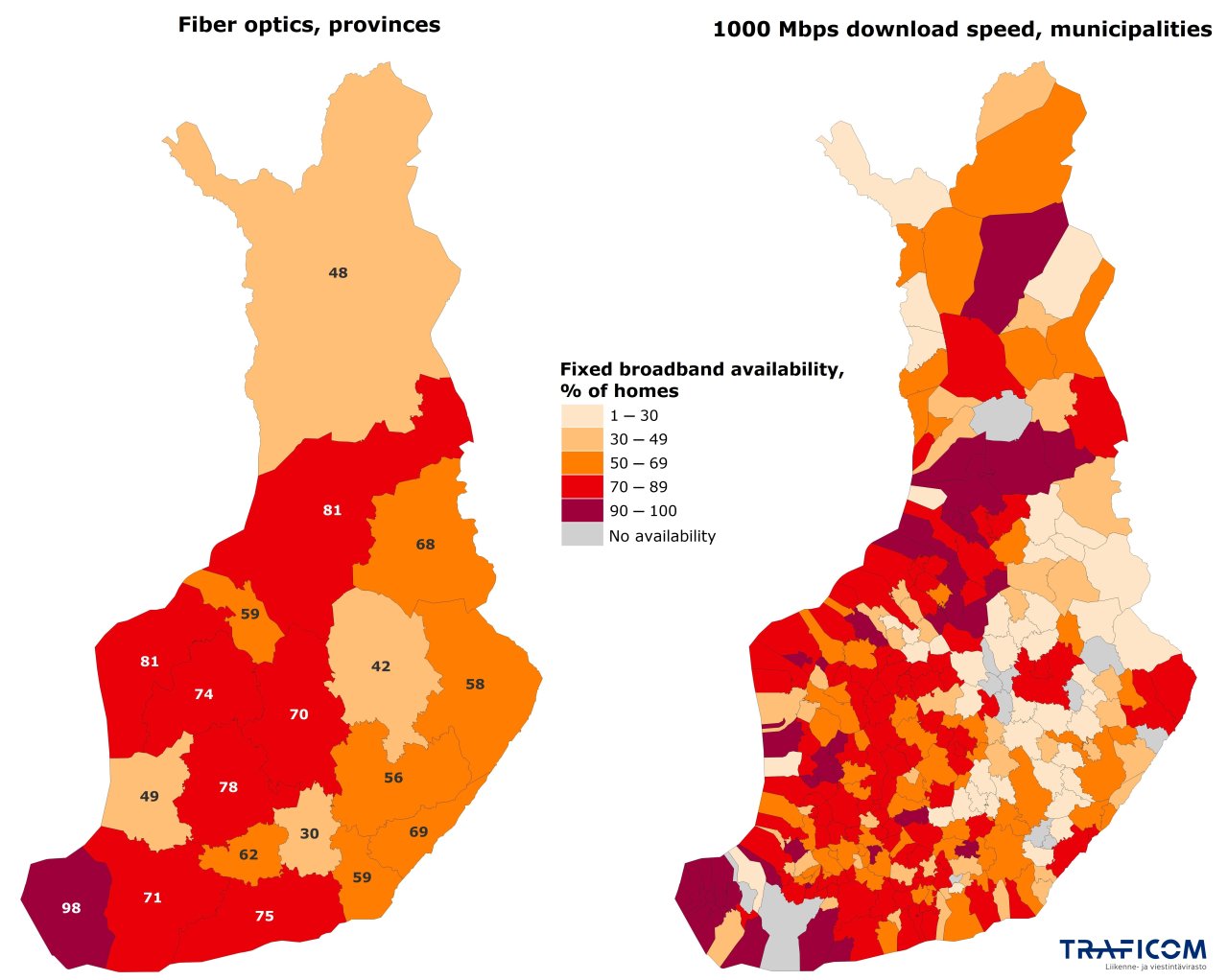
Figure 1. Availability of the fibre-optic network by region and 1000 Mbps download speeds by municipality at the end of September 2024.
High-speed broadband network coverage is high in cities – but major regional differences remain
Finnish telecommunications operators have increased their investments in fixed networks. This trend is particularly reflected in the expansion of the fibre-optic network, which can be seen throughout Finland, and especially in larger population centres with no previous fibre-optic network availability. Fibre-optic coverage has improved the most in rural local centres, outer urban areas, and urban fringe areas. However, sizable regional differences still remain.
In urban areas, the availability of high-speed fixed networks is generally good. In September 2024, over 90% of households in both inner and outer urban areas had access to at least 100 Mbps connections, while 70% had access to fibre-optic connections.
Around 25% of Finns live in rural areas where high-speed fixed broadband connections are almost entirely based on fibre-optic technology. The situation of fixed broadband connections in rural local centres is good: 81% of households had access to 100 Mbps connections, and 78% to fibre-optic networks. The situation is less stellar in rural areas located close to cities and in sparsely populated rural areas. Here, more than half of households are completely without a fast fixed connection.
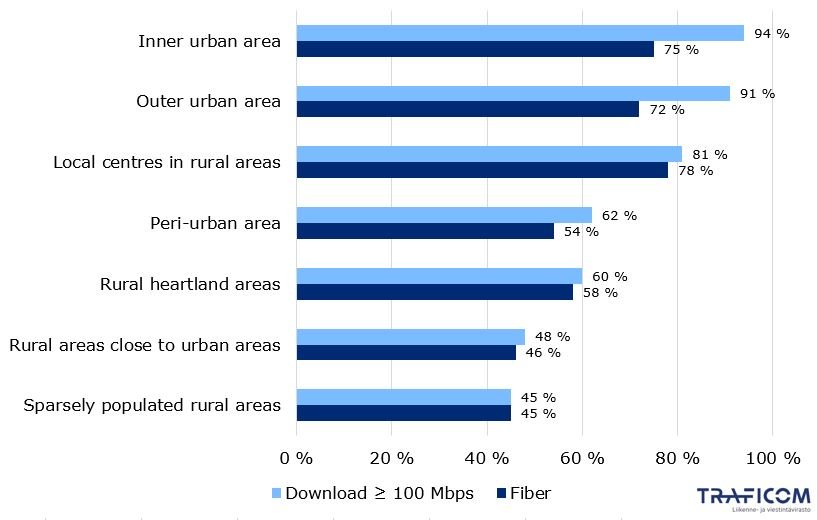
Figure 2. Availability of fixed, 100 Mbps download speeds and optical fibre to households in 2024, according to the Finnish Environment Institute’s urban-rural classification.
Enquiries and more information
Fixed broadband availability Fixed broadband availability Ulkoinen verkkopalvelu.
Traficom’s map service Ulkoinen verkkopalvelu.
Finnish Environment Institute’s urban-rural classification Ulkoinen verkkopalvelu. (in Finnish)
Joonas Sotaniemi, Senior Specialist, tel. +358 29 539 0309, joonas.sotaniemi@traficom.fi
Marja Heinonen, Senior Specialist, tel. +358 29 534 7355, marja.heinonen @traficom.fi