
Driving licence models used in Finland | Traficom
Transport and Communications Agency

Driving licence models used in Finland

The security features and appearance of the driving licence are updated every few years. The latest changes were made in the spring of 2024. Since 2013, new driving licences have complied with the standardised single European driving licence model used across the EU. In Finland, the centralised registration of driving licences dates back to 1972.

A standardised driving licence model will be introduced in the European Union over the period 2013–2033. Driving licences issued before 2013 can be used in Finland until 2033.

Driving licence model introduced in 2024

The latest updates to the appearance and security features of the driving licence were made in April 2024. 

The card got a new background printing pattern, and some of the security features were further improved. The new card includes a transparent window with the licence holder’s facial photograph, for example.
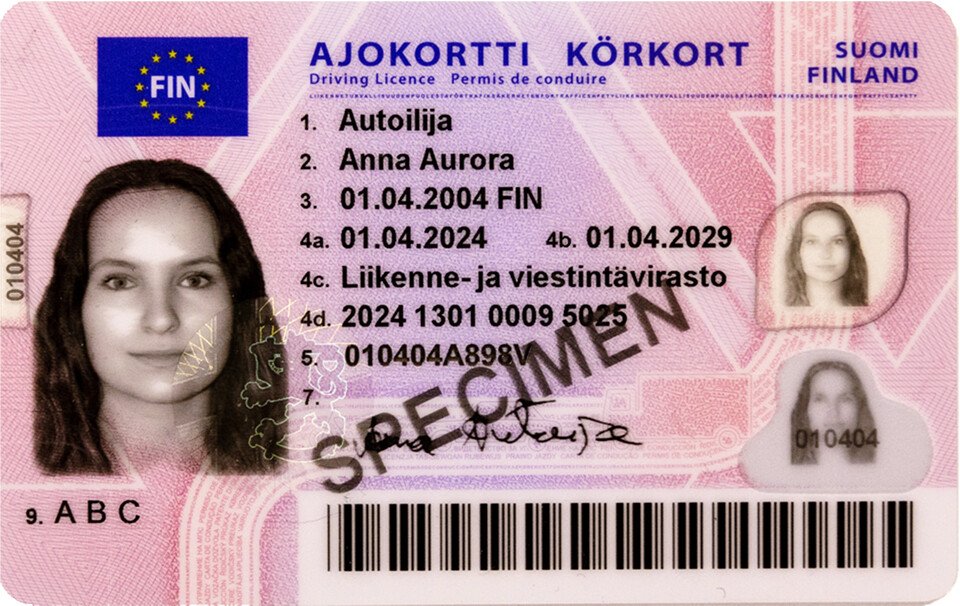
Vuoden 2024 ajokorttimallin etupuoli

Front side of the 2024 driver's license model.
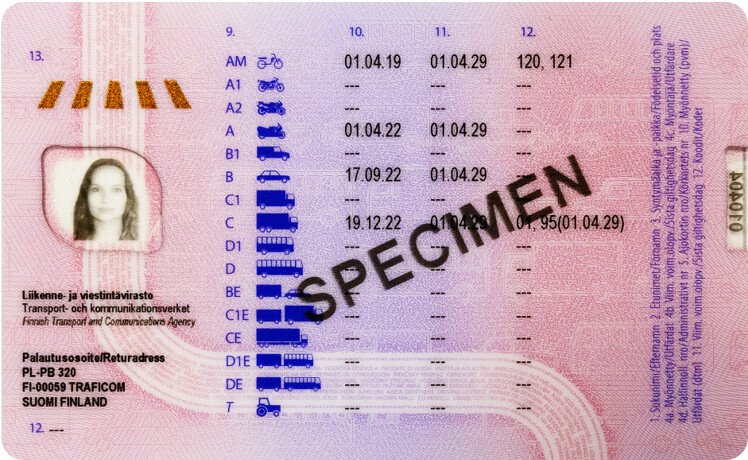
Vuoden 2024 ajokorttimallin kääntöpuoli

Back side of the 2024 driver's license model.

Driving licence model introduced in 2019

The appearance of the driving licence was previously updated in April 2019. The card got a new background printing pattern, and some of the security features were improved.

The raised engraving on the front side of the licence was changed so that it overlaps with the facial photograph, for example.

On the back, the category LT for road-rated tractors was removed from the table of licence categories because it is no longer used.
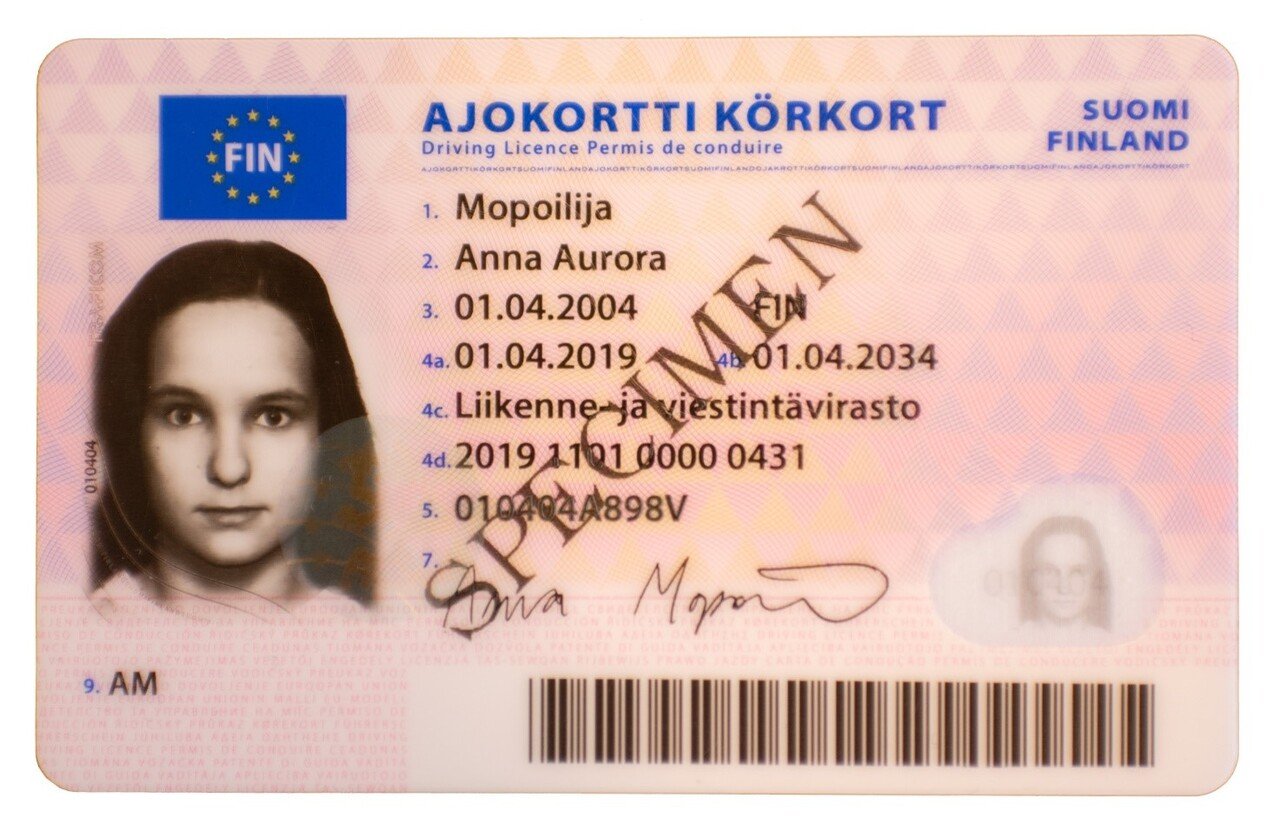
Vuoden 2018 ajokorttimallin etupuoli

Front side of the 2019 driver's license model.
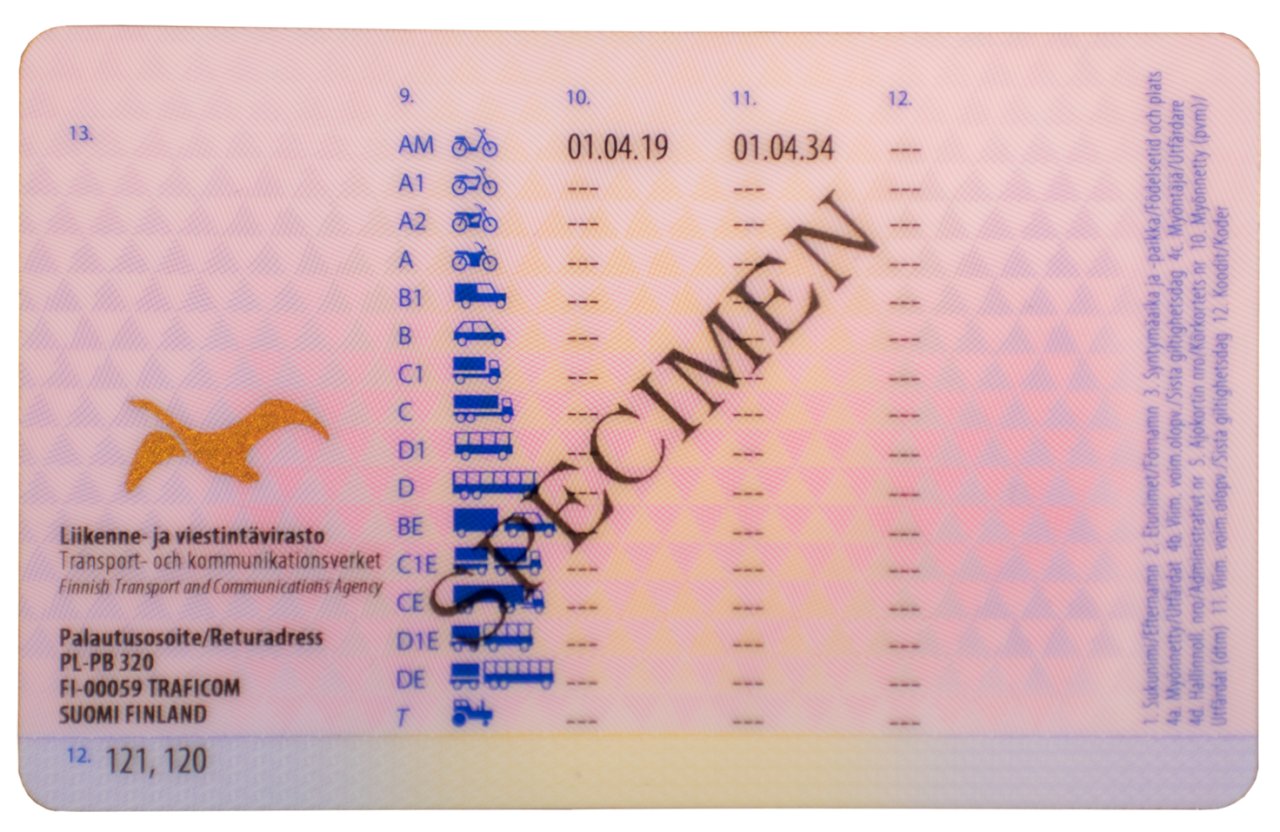
Ajokorttimalli. Käyttöönotto 2019 kääntöpuoli

Back side of the 2024 driver's license model.

Driving licence model introduced in 2013

The first driving licence model that complied with EU standards was introduced on 19 January 2013.

An optically variable device (OVD) was added to the lower-right corner of the holder's photograph, and the variable laser image in the lower-right corner of the card was amended to display either the holder's photograph or date of birth.

The card's background design was also altered, and the words for "driving licence" were added to the header in English and French.

When Croatia joined the European Union in June 2014, the Croatian term for "driving licence" was added to the background design of the licence.

At the same time, the f in Trafi's logo on the reverse of the licence was changed from a capital F to a lower-case f.
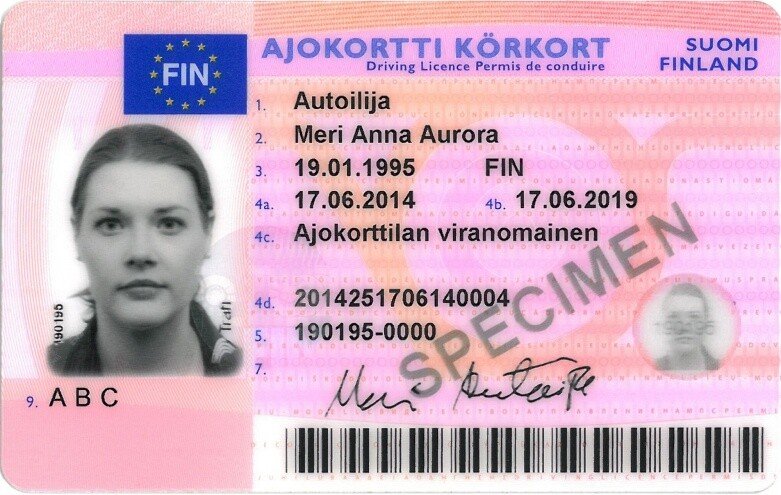
Vuoden 2013 ajokorttimallin etupuoli

Front side of the 2013 driver's license model.
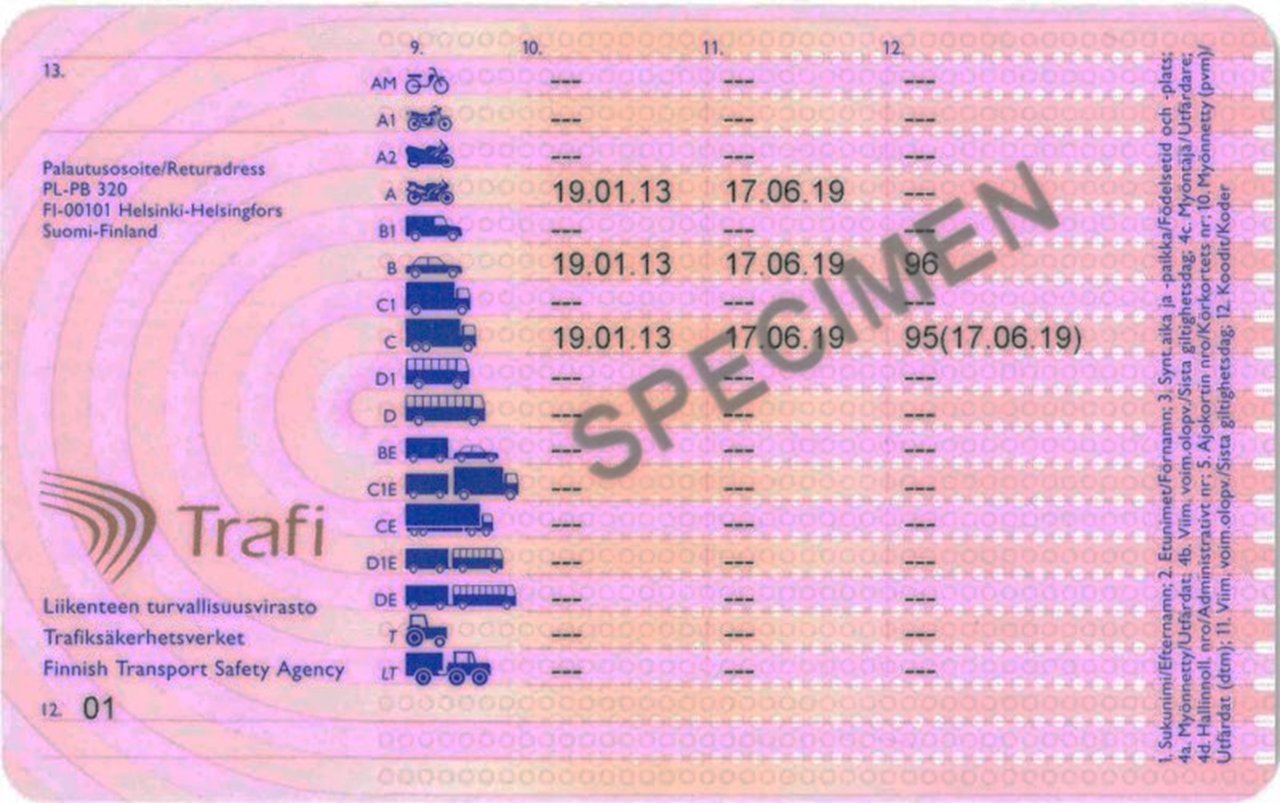
Vuoden 2013 ajokorttimallin kääntöpuoli

Back side of the 2013 driver's license model.

Driving licences issued in 1972–2013 are valid until 2033. 

The centralised registration of driving licences in Finland began in July 1972.

Registration sought to boost the effectiveness of driving licence control, minimise the potential for forgery, standardise driving licence practices, and improve the opportunities for conducting research and compiling statistics.

By the end of 1972, almost 140,000 licences had been entered into the centralised driving licence register. At the end of 2024, the register held details for about 3.8 million licence holders.

The establishment of the centralised driving licence register was accompanied by a reclassification of driving licences.

A pink cardboard licence was also introduced at this time under the Vienna Convention on Road Traffic. At the end of 2024, some 100,000 people in Finland were still using the old cardboard driving licence.

Cardboard driving licence

Vuoden 1972 ajokorttimalli

Cardboard driving licence from 1972.

Two-phase driving licence system introduced

A two-phase system for obtaining a passenger car driving licence was introduced in Finland in October 1989.

After completing the first phase, an applicant received a short-term driving licence for two years. 

A course of further instruction was required to obtain a full licence, and this could be taken at the earliest six months after obtaining the short-term licence.

From 1996, you could not obtain a full licence until a year and a half after obtaining the short-term licence. The two-phase system was in force until January 2013.

.

New Driving Licence Decree and the driving licence as part of the road traffic information system

A new A7 plastic driving licence was introduced in October 1990. The procedure for issuing driving licences also changed so that licence applicants had to first apply to the police for a driving licence permit. The permit has been a precondition for a driving licence ever since. The driving examiner immediately issued a short-term licence to those who passed their driving examination.


Vuoden 1990 ajokorttimallin etupuoli

Front of year 1990 driving licence.

Vuoden 1990 ajokorttimallin kääntöpuoli

Back side of year 1990 driving licence.

Changes introduced by EU membership

By joining the EEC, Finland committed to complying with the EC Driving Licence Directive and bringing its legislation in line with the Directive by 1 July 1996.

Finland joined the EU in January 1995. The Driving Licence Directive also required the introduction of the EU driving licence. 

Finland was given more time to implement the required changes (until the end of 1997).

The Driving Licence Directive meant the following changes:

  • two new driving licence categories: A1 and D1
  • restrictions and extensions were added to the right to drive a motorcycle (Category A), and these details had to be recorded in the licence
  • the licence had to indicate if a licence holder had been granted a right to drive without completing a Finnish driving examination based on a licence issued in a non-EU or non-EEC country
  • the right of Category B licence holders to drive certain vehicle combinations was restricted

With an application submitted before the end of 1996, Category B licence holders could be granted the right to drive a vehicle in Category BE ("small E") without the need to take a driving examination or provide a medical certificate.

More than 980,000 people applied for the BE driving licence, although only some of them required its entitlements.

EU driving licence introduced in January 1998

A new driving licence the size of a credit card (the EU driving licence) was introduced from the beginning of 1998. It contained information that had been lacking in earlier versions.

The new details shown on the front of the licence are the holder's country of birth, the date of issue, and the licence number.

The reverse side shows the driving licence categories, which are also displayed as images. Start and end dates for the right to drive each category of vehicle were added to the back of the card. Potential special conditions could also be indicated by vehicle category. Some of the most common special conditions are still glasses (01), duplicate of the driving licence (103) and professional aptitude (95).

There is also room on the licence for details of organ donation. Provision has also been made for a microprocessor, should one be required in the future.

Vuoden 1998 ajokorttimallin etupuoli

Front side of the 1998 driving licence.

Vuoden 1998 ajokorttimallin kääntöpuoli.

Back of the 1998 driving licence.

Moped licence introduced: examination required

A new driving licence category, Category M, was introduced for mopeds at the beginning of 2000. 

It entitles the holder to drive mopeds and light quadricycles (i.e. moped cars and small quad bikes). 

The Category M licence requirement only applies to those born on or after 1 January 1985. Anyone born before the said date can drive a moped without a moped licence.

However, everyone needs a driving licence for driving a moped car.

In order to receive a moped licence, you had to be at least 15 years of age, have a driving licence permit, and have passed the theory test of your driving examination.

Mopon ajokortin etupuoli

Front side of the moped driving licence.

Mopon ajokortin kääntöpuoli

Back side of the moped driving licence.

EU enlargement in 2004 – changes to the driving licence

Ten new countries joined the European Union in May 2004: Estonia, Latvia, Lithuania, Poland, Czech Republic, Slovakia, Hungary, Slovenia, Malta and Cyprus.

As a result, the words for "driving licence" were also printed on the licence in the languages of the new Member States.

The text "FIN", which used to appear along the top right, was moved to the bottom. On the front of the licence, an AKE logo colour-printed in OVI was added to the lower-right corner.

The Ministry of Transport and Communications validated the new driving licence model on 12 January 2004.

Vuoden 2004 ajokorttimallin etupuoli

Front side of the 2004 driving licence.

EU enlargement in 2007 – changes to the driving licence

Bulgaria and Romania joined the European Union on 1 January 2007. As a result, the words for "driving licence" were also printed on the licence in the official languages of these countries.

The Ministry of Transport and Communications validated the new driving licence model on 1 February 2007.

Vuoden 2007 ajokorttimallin etupuoli

Front side of 2007 driving licence.

Improved security features in 2010

The driving licence's security features were improved on 10 April 2010. The AKE logo colour-printed in OVI was replaced with a three-dimensional variable laser image (MLI).

The variable laser image shows the holder's year of birth, the Trafi logo and the abbreviation "FIN", depending on the angle of view.

Vuoden 2010 ajokorttimalli

Front side of 2010 driving licence.

Page was last updated