
More transparency now required when AI is used – Traficom published guidance on new obligations
The EU Artificial Intelligence Act introduces new transparency obligations that help people recognise when artificial intelligence (AI) is being used and when content has been generated by AI. In Finland, the Finnish Transport and Communications Agency Traficom is the main authority supervising compliance with these obligations.
The transparency obligations under the EU Artificial Intelligence Act (AI Act) have applied since 2 August 2026. They apply to both providers and deployers of AI systems. Under the obligations, people must be informed when AI is being used and certain AI-generated or manipulated content must be labelled.
The use of AI in interactions within digital services, and particularly in content generation, is already very common. The transparency obligations apply to a large number of companies and individuals and have already raised many questions among operators.
“The purpose of the transparency obligations is to ensure that people can recognise the use of AI in different situations and assess the origin and reliability of content. Traficom’s role is to supervise compliance with the transparency requirements in Finland and ensure that citizens and organisations have access to clear information on how the obligations apply,” says Director Jenni Koskinen at Traficom.
Traficom supervises compliance in Finland
In Finland, Traficom is the main authority supervising compliance with the AI transparency obligations. Sector-specific market surveillance authorities supervise compliance with the transparency obligations applicable to providers and deployers of high-risk AI systems.
The European Commission, in turn, supervises cases where an AI system is based on a general-purpose AI model and the same provider develops both the model and the system, as well as AI systems connected to very large online platforms, such as Facebook and X.
AI-generated or manipulated images, video and audio can be used, for example, to mislead people. An image, video or statement by a person that appears authentic may in fact have been generated entirely by AI. The transparency obligations are intended to help people recognise such content and assess its reliability more effectively.
“Transparency builds trust in digital services. When the use of AI is communicated clearly, people are better able to assess content and use services with greater confidence. At the same time, common rules help companies adopt AI responsibly. It is also important to remember that the vast majority of content produced with the help of AI is entirely acceptable and useful,” says Head of Unit Jarmo Riikonen.
Labelling obligations apply to both system providers and content creators
Based on Traficom’s experience, organisations should consider the transparency obligations as part of their normal AI governance rather than as a separate requirement.
The most important thing is to identify the services, processes and content in which AI is used and to ensure that the required notices and labels are implemented appropriately. An operator’s responsibilities depend on their role and on how they use AI.
- A provider of an AI system must inform a person when they are interacting directly with the AI system, for example with a chatbot. However, no notice is required if it is obvious from the context that the person is interacting with AI.
- A provider of an AI system that generates synthetic image, video, audio or text content must ensure that content generated or manipulated by the system can be detected as artificially generated or manipulated.
- A deployer of an AI system must inform people exposed to an emotion recognition system or a biometric categorisation system that the system is being used.
- A deployer must also clearly disclose when published content constitutes a deep fake within the meaning of the AI Act. The obligation to disclose the use of AI also applies to AI-generated or manipulated text published for the purpose of informing the public on matters of public interest. The obligations on deployers apply when the system is used for purposes other than personal, non-professional activity.
The required information must be provided clearly and in a distinguishable manner no later than the first time a person interacts with the system or is exposed to the content concerned.
However, not all AI-generated content needs to be labelled. If AI-generated content is not so realistic that it could mislead a person into thinking that it is authentic, no label is required. In such cases, there is no need to notify the authority about the absence of a label.
Traficom recommends using the European Commission’s guidelines, Code of Practice and icons when implementing the transparency obligations. They provide practical ways of complying with the requirements, but operators always remain responsible for meeting their obligations.
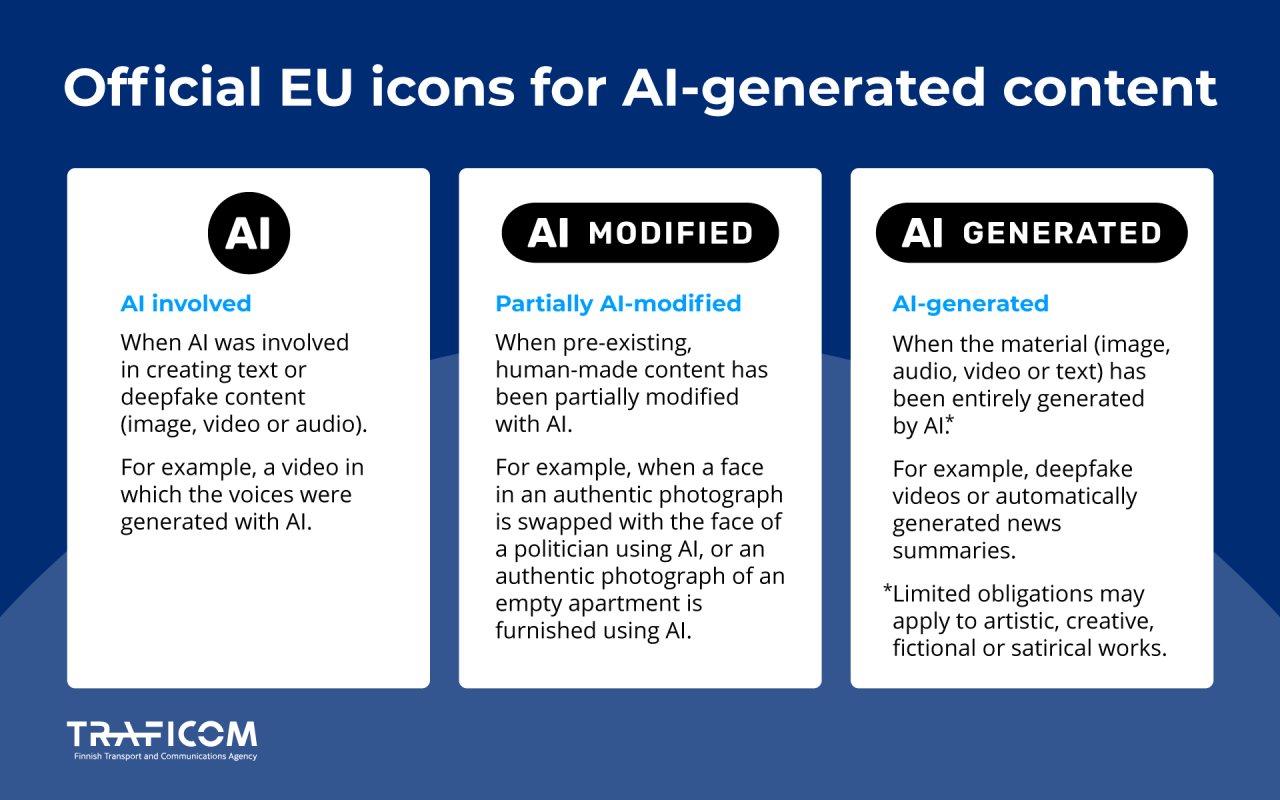
Providers of AI systems placed on the market before 2 August 2026 must comply with the machine-readable marking requirement by 2 December 2026 at the latest. The other transparency obligations apply without a corresponding transitional period.
What does Traficom supervise?
In Finland, Traficom is the main authority supervising compliance with the transparency obligations under the AI Act. Its supervision includes assessing whether the use of AI has been disclosed as required by the Act and whether certain AI-generated or manipulated content has been appropriately labelled.
Traficom advises operators on how the obligations apply and also processes reports of possible shortcomings.
Traficom will also publish further guidance on its website on how the transparency obligations apply and information on how possible infringements can be reported to the authority. Traficom also monitors the practical effects of the obligations in Finland and cooperates with other national and European supervisory authorities.
Enquiries and more information
Jenni Koskinen, Director, tel. +358 29 539 0648, jenni.koskinen@traficom.fi
Jarmo Riikonen, Head of Unit, tel. +358 29 534 7385, jarmo.riikonen@traficom.fi
Instructions
Operators must identify their own obligations
If you are a provider of AI systems or if you, as a deployer of an AI system, produce AI-generated content:
- identify the situations in which the system generates AI content
- assess which transparency obligations apply to your case
- introduce the necessary notice and labelling solutions
- update your internal guidance and procedures as necessary.
If you are subject to a labelling obligation, you may decide how to implement the label, provided that it complies with the requirements of the AI Act.
You can report inadequately labelled AI-generated content to Traficom
- If you encounter content or a service that you suspect has been generated or manipulated by AI:
- check whether the content is labelled as having been generated or manipulated by AI
- assess whether the content could give a misleading impression of an authentic event, person or statement
- if necessary, ask the content producer how the content was produced
- if you suspect that the transparency obligations have been infringed, you can report the matter to Traficom.